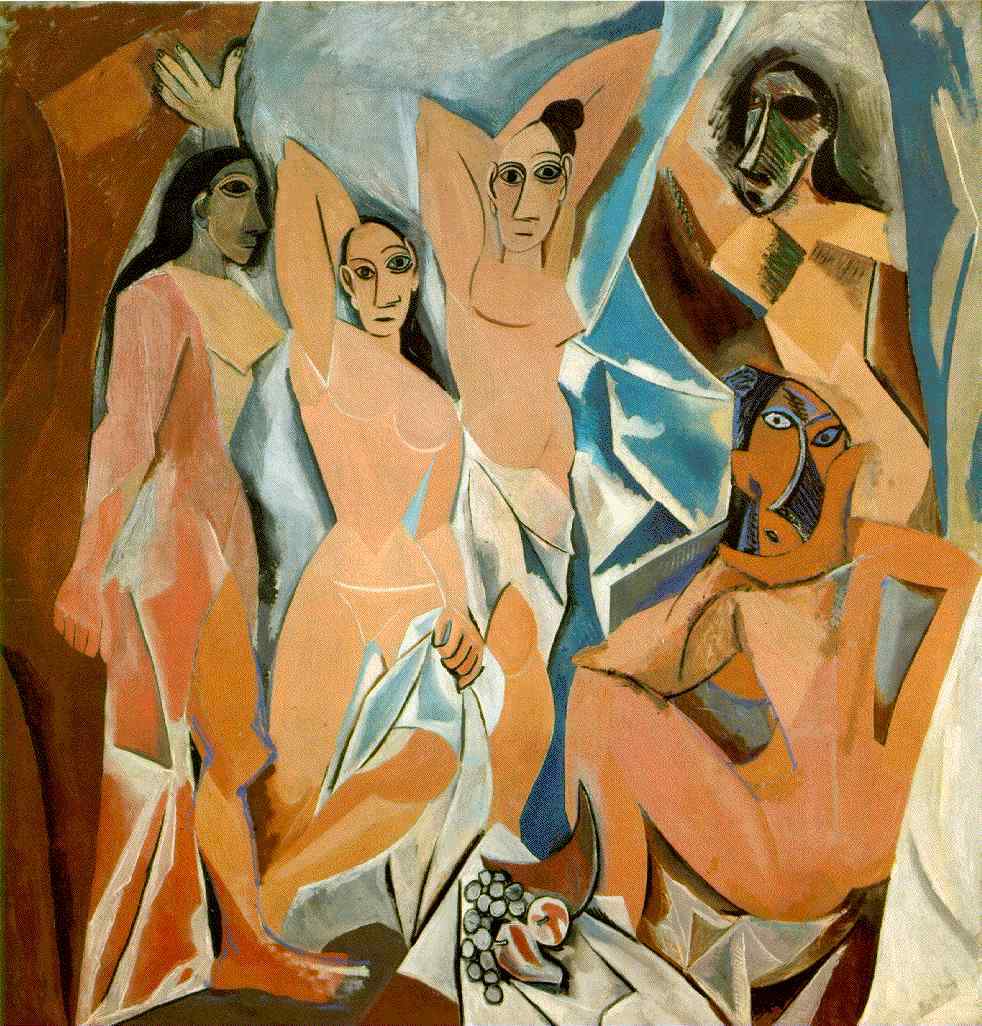
Drawing is not my forte; I can do flowers and rainbows all day long, but drawing even semi-human figures takes some skill that I do not possess. I love and appreciate art, so to try to replicate someone as renowned as Picasso was scary, and then to turn his picture upside down added a layer of difficulty. Though I started strong and confident, I ended my drawing with a recognition of my skills in the area of attention to detail, patience, and planning.
The first thing I tackled when drawing was to section off a piece of the painting, so I only needed to focus on about a 4 inch by 8 inch slice of the photo. I began drawing and realized that I was starting at the top of the paper, but I needed to start at the bottom since I was drawing from the top of the painting. Drawing the top went quickly; I assumed it would go slowly as the faces are at the top, but the speed might have related to my confidence and excitement, which was quickly eroded.
The next thing I tackled was the bodies of the women. I felt good about my plan to section off pieces of the painting, but that plan fell apart when I got to the bodies. I noticed how the painting's focus on the human figure distorted my ability to draw bodies. It was easy to focus on faces because they were pretty standard with eyes and ears. However, the bodies became a tangled mess as the eye travels to the bottom of the image. That complexity was a detail I missed in my planning; I didn't fully absorb the painting right side up before turning it upside down.
As I neared the bottom, my quiet space became filled with noises of "what's for lunch" and "she's being mean to me." Losing my train of thought, my patience with my poor planning, and my patience with my noisy environment, I quickly wrapped up what I saw at the bottom of the painting. I had lost all interest in the ability to execute this quickly and accurately, despite knowing that I am not a trained, or even semi-trained artist.
While Picasso's goal of this painting is empowerment in simplicity, his figures are not simple to recreate upside down. Changing perspectives did offer a new-found respect for his technique. However, much of my battle was not drawing upside down, but for not studying the painting and all its small details. I thought since I had viewed the painting a hundred times before, I knew what the painting contained. I quickly realized I didn't know the painting at all.
Working on assumptions is a major weakness for a researcher. As a researcher, I will need to be sure that I bring no assumptions to my observations, so that I can see everything that is there. I additionally cannot give up when I cannot "see" things the way I want to see them; I need to have a plan AND be willing to alter the plan, so that I can gather accurate data.
Saturday, March 26, 2016

Stretch Activity #4: Upside Down Picasso
Picasso is one of my favorite artists; I chose him because I think his cubist period would be fairly easy to draw. Here's the painting I chose to copy, but the rub is to try to draw it while it is upside down:

Here is my version:

Here is my version:

Friday, March 18, 2016
Reflection on Stretch #3
An observation of Walmart on a busy night is challenging. Sometimes people would talk to me as they passed by, while others clutched their merchandise so tightly I could not see what they were buying. The greatest challenge, however, was ignoring the loud child.
My first obstacle came in the way of customer interference. The Walmart in this small town is a hot spot because for many this is a grocery store, a clothing store, an art store, a home store, and a pet store. As such, I often see someone I have taught, worked with, volunteered with, or with whom my daugheters go to school. My active life has allowed very few degrees of separation. However, many times people in this small town are just friendly or observant. A few asked if I was waiting for someone, as if they could help me find said person, while others commented on the warm streak of weather, or the smell wafting from the Subway behind me. Still, others wanted to cut up and laugh, and I am always up for a friendly exchange or laugh.
Another challenge was determining what people were buying. Many people were clutching their purchases so tightly so quickly I had little time to see what they were or even write it down. This speaks to the hustle and bustle that happens in express lines; people expect and feel they need to get through quickly.
My greatest challenge was ignoring the demanding toddler; I found it difficult to NOT know what he was saying, or to try to figure out what motivated him or what he was running toward when he trotted away from Grandma each time. Their relationship was fascinating not just because of the mystery behind his rant, but also because Grandma seemed cool and collected. I was afraid I would miss her sudden burst of frustration or even action. Watching the tiny terror meant I missed recording a few key purchases.
The takeway in observing but not participating is that sometimes you get sucked in. Sometimes, the harder you try to be that fly on the wall, someone still sucks you back in. And other times, you get sucked in by a phenomenon you did not expect. Having a plan is great, but learning to adjust to the unexpected is a more realistic skill for any qualitative researcher.
My first obstacle came in the way of customer interference. The Walmart in this small town is a hot spot because for many this is a grocery store, a clothing store, an art store, a home store, and a pet store. As such, I often see someone I have taught, worked with, volunteered with, or with whom my daugheters go to school. My active life has allowed very few degrees of separation. However, many times people in this small town are just friendly or observant. A few asked if I was waiting for someone, as if they could help me find said person, while others commented on the warm streak of weather, or the smell wafting from the Subway behind me. Still, others wanted to cut up and laugh, and I am always up for a friendly exchange or laugh.
Another challenge was determining what people were buying. Many people were clutching their purchases so tightly so quickly I had little time to see what they were or even write it down. This speaks to the hustle and bustle that happens in express lines; people expect and feel they need to get through quickly.
My greatest challenge was ignoring the demanding toddler; I found it difficult to NOT know what he was saying, or to try to figure out what motivated him or what he was running toward when he trotted away from Grandma each time. Their relationship was fascinating not just because of the mystery behind his rant, but also because Grandma seemed cool and collected. I was afraid I would miss her sudden burst of frustration or even action. Watching the tiny terror meant I missed recording a few key purchases.
The takeway in observing but not participating is that sometimes you get sucked in. Sometimes, the harder you try to be that fly on the wall, someone still sucks you back in. And other times, you get sucked in by a phenomenon you did not expect. Having a plan is great, but learning to adjust to the unexpected is a more realistic skill for any qualitative researcher.
Sunday, March 13, 2016
Stretch Activity #3: Nonparticipant Observation of Walmart Customers
I recently visited Walmart in Nashville, NC for dog food. It was a very busy Friday, so I decided to practice my observation skills and jot down notes about the phenomenon of the large, one-stop superstore.
I decided to sit on a bench by the entrance which housed the deli and the produce to the right of me. This entrance also encompassed the Subway behind me, and the express line directly in front. It was a Friday night around 7:00; I expected the Walmart to be less busy as sports are in full swing and Friday is when people typical go out to eat or the movies, but I also realized it was payday for many, and thus many are hitting Walmart after getting home from work.
This grocery end of the store, with the express line, gave me a quick glimpse into what people buy when they need to run in quickly. Food items were the most common items; however, it wasn't milk or bread but snack items that seemed to be the most common. A few people struggled to hold their items, while one or two of the dozen people had a cart.
I noticed quickly that the majority of the people in the express line were with kids. The two people with the cart had kids, which was logical because the kids typically ride in the cart. Several other kids were standing with an adult; most were between 6 and 10 years old.
The customers in the express line wore a variety of clothing; two women were in scrubs, and one man was in a maintenance uniform. Most of the people in line looked between 30 and 45 years old, and the racial composition was about 50% African American and 50% white, with two children who seemed to have parents of different races. This composition was pretty typical for what I've experience the handful of times I've visited this Walmart in the past five years.
Everyone in the two lines was very distracted by one little boy, probably about 2. He was shouting loudly at a woman who seemed to be his grandmother; his speech was typical for his age, and all I could make out was "I don't know what you talkin' bout." His voice was very guttural; every so often he'd stomp his foot when his grandmother asked him to quit his mess and "come heah before I get your reah when we get home." He'd stomp the same 10 feet, getting about 3 feet to should his line, then run toward the door with his arms up like he was gonna fly. It seems I had started observing in the middle of something, as I couldn't tell what the catalyst was for his rant. Reactions by the customers in line ranged from laughter from the older, childless customers to a stern reprimand from those with kids that they'd better not act like that.
The line seemed to move very slowly; often the cashier had to search for a price on an item. Most people had over ten items, which also meant the wait would be longer. No one seemed overly annoyed about the wait; people would wait to see what grandma would do about her grandson's threatening voice. I wanted to wait to see if grandma was going to make good on her threats, but I had to leave.
I decided to sit on a bench by the entrance which housed the deli and the produce to the right of me. This entrance also encompassed the Subway behind me, and the express line directly in front. It was a Friday night around 7:00; I expected the Walmart to be less busy as sports are in full swing and Friday is when people typical go out to eat or the movies, but I also realized it was payday for many, and thus many are hitting Walmart after getting home from work.
This grocery end of the store, with the express line, gave me a quick glimpse into what people buy when they need to run in quickly. Food items were the most common items; however, it wasn't milk or bread but snack items that seemed to be the most common. A few people struggled to hold their items, while one or two of the dozen people had a cart.
I noticed quickly that the majority of the people in the express line were with kids. The two people with the cart had kids, which was logical because the kids typically ride in the cart. Several other kids were standing with an adult; most were between 6 and 10 years old.
The customers in the express line wore a variety of clothing; two women were in scrubs, and one man was in a maintenance uniform. Most of the people in line looked between 30 and 45 years old, and the racial composition was about 50% African American and 50% white, with two children who seemed to have parents of different races. This composition was pretty typical for what I've experience the handful of times I've visited this Walmart in the past five years.
Everyone in the two lines was very distracted by one little boy, probably about 2. He was shouting loudly at a woman who seemed to be his grandmother; his speech was typical for his age, and all I could make out was "I don't know what you talkin' bout." His voice was very guttural; every so often he'd stomp his foot when his grandmother asked him to quit his mess and "come heah before I get your reah when we get home." He'd stomp the same 10 feet, getting about 3 feet to should his line, then run toward the door with his arms up like he was gonna fly. It seems I had started observing in the middle of something, as I couldn't tell what the catalyst was for his rant. Reactions by the customers in line ranged from laughter from the older, childless customers to a stern reprimand from those with kids that they'd better not act like that.
The line seemed to move very slowly; often the cashier had to search for a price on an item. Most people had over ten items, which also meant the wait would be longer. No one seemed overly annoyed about the wait; people would wait to see what grandma would do about her grandson's threatening voice. I wanted to wait to see if grandma was going to make good on her threats, but I had to leave.
Monday, March 7, 2016
Reflection on Stretch Activity #2
Being a movie monitor had its own set of challenges. As a researcher sitting in the movie, I had to not only adjust to the content of the movie, but the surroundings in which I viewed the movie.
Deadpool was a very violent and graphic movie; though I found many of the scenes requisite to the character's development, these scenes and situations are hard for me because I am a survivor of domestic violence. I have not seen Selma, Twelve Years a Slave, nor many other movies because I struggle with handling violence in that capacity. I have even walked out of several movies because the violence was too much. I became really aware of my discomfort with violence through this stretch activity.
I was required to notice who was around me during the movie as I chose where to sit and how to react to scenes in the movie. Because of the small group viewing the movie, I wasn't as reactive in terms of laughter or fear because I would have been singled out; it is more comfortable to react to something when a larger group will reaffirm or mask my reaction. As I left I noticed a young boy of maybe ten had viewed the movie; had I known that child was in the movie with me, I may not have been able to sit through it. Knowing a young child was witnessing such a graphic movie would have bothered me and I would not have been able to appreciate or enjoy the movie.
I've learned that sometimes I will, as a researcher, be in very uncomfortable situations. I'll need to develop a set of skills to be sure that anyone I interview will feel comfortable with me; I cannot react with horror or withdraw when a focus group or interview detours into uncomfortable territory.
Deadpool was a very violent and graphic movie; though I found many of the scenes requisite to the character's development, these scenes and situations are hard for me because I am a survivor of domestic violence. I have not seen Selma, Twelve Years a Slave, nor many other movies because I struggle with handling violence in that capacity. I have even walked out of several movies because the violence was too much. I became really aware of my discomfort with violence through this stretch activity.
I was required to notice who was around me during the movie as I chose where to sit and how to react to scenes in the movie. Because of the small group viewing the movie, I wasn't as reactive in terms of laughter or fear because I would have been singled out; it is more comfortable to react to something when a larger group will reaffirm or mask my reaction. As I left I noticed a young boy of maybe ten had viewed the movie; had I known that child was in the movie with me, I may not have been able to sit through it. Knowing a young child was witnessing such a graphic movie would have bothered me and I would not have been able to appreciate or enjoy the movie.
I've learned that sometimes I will, as a researcher, be in very uncomfortable situations. I'll need to develop a set of skills to be sure that anyone I interview will feel comfortable with me; I cannot react with horror or withdraw when a focus group or interview detours into uncomfortable territory.
Subscribe to:
Posts (Atom)